Running an experiment
An experiment starts as a question: does my branch relay more than dev on this network, does raising the hop cap buy delivery or just airtime. The machinery exists to answer it credibly: a control arm as the baseline, one variable changed per arm, several seeds per arm, and the difference read against the control's own spread rather than against hope.
A sweep is a matrix, not an A/B: arms crossed with seeds, run one at a time against the same network, with the results tabulated side by side.
Running one#
- Load the network. A shipped
-strictfixture is the usual arena. Everything below holds it constant, so pick it first. - Open the Bench view. Sweep, Runs, Experiment log, Matrix, Timelines and Configuration, and no map: an experiment is read, not sited.
- Set the constants.
experiment.baseholds what every arm shares, most importantly the firmware versions for the roles you are *not* varying. A freshly imported node carries no firmware reference at all, which resolves to MeshCoremain, for which nothing is published, and the sweep dies on its first run. - Define the arms, including a control. Each arm is a label plus what differs: a firmware version, a loop-detection setting, a path-hash size, a CAD setting. The control is the unchanged source under a second label; if the control arms disagree, nothing else measured that day means anything.
- Choose seeds and senders. Pick senders spread across the map rather
than the first few in the list: a cluster of neighbours contends with itself
instead of with the mesh.
experiment.senderstakes the node names. - Start it, and watch the log. Each run boots every node's firmware, settles, sends, and tears down.
- Export.
experiment.exportwrites an HTML report with every arm, every run and the deltas between them.
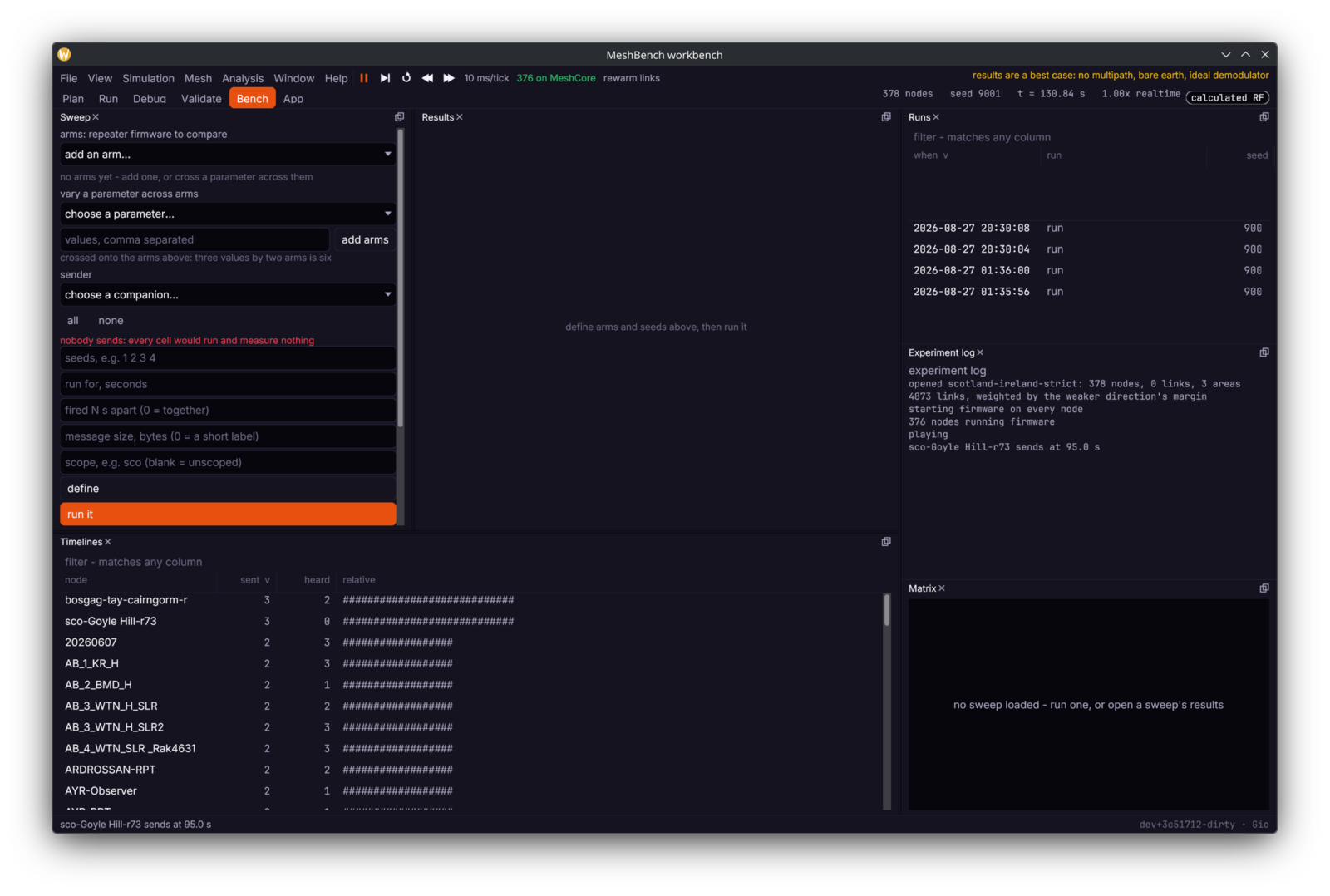
The numbered steps above are the Bench view's Sweep panel, top to bottom; define stores the matrix and run it starts it.
Everything is on the Sweep panel in the order listed above. The Runs panel fills as each cell completes, and Results tabulates the arms side by side.
{"id":1,"method":"experiment.senders","params":{"senders":["Abernethy Repeater","Largo Law","Cluny Clay","West Lomond"]}}
{"id":2,"method":"experiment.define","params":{
   "arms":[{"label":"control","repeater_version":"repeater-v1.17.0"},
           {"label":"my branch","repeater_version":"my-arm"}],
   "seeds":[1,2,3],"scope":"#sco","run_for_ms":90000}}
{"id":3,"method":"experiment.start"}
{"id":4,"method":"experiment.state"}
{"id":5,"method":"experiment.export"}wb.call("experiment.senders", {"senders": ["Abernethy Repeater", "Largo Law"]})
wb.call("experiment.define", {"arms": [...], "seeds": [1, 2, 3],
"scope": "#sco", "run_for_ms": 90000})
wb.call("experiment.start")Neither client shapes the experiment verbs yet; both drive the raw calls, so the socket tab is the reference:
_, err := wb.Call(ctx, "experiment.start", nil)What comes out#
| metric | meaning |
|---|---|
tx | transmissions, summed over every node |
rx | successful receptions |
delivered | unique deliveries - a message reaching a node it had not reached |
redundant | receptions of something already heard, the cost of flooding |
collisions | receptions lost to overlapping transmissions |
airtime_ms | total time the network spent transmitting |
rx_spread | how much rx varied across the arm's seeds - the arm's own noise floor |
at_risk_2db | deliveries within 2 dB of the demodulator floor, absent when no run measured it |
Airtime, collisions and redundancy are the metrics that answer "is this change good for the network" rather than "did this message arrive". They are reported for every arm without being asked for, and rx_spread is the number every delta must beat before it means anything.
Every run and every arm summary also carries builds: the firmware each role actually ran, as {role, version, file, bytes}. A sweep exists to compare builds, and a delta means nothing unless the arms ran what they claimed, so the record says which build each one was. Two arms that come back identical are then a real result rather than two arms that never switched, and the file and its size tell two builds under one label apart: local-main is rebuilt in place, and two runs a week apart are not the same binary.
Designing one that survives scrutiny#
Put a control in the matrix. Two arms the firmware guarantees are identical are a free reproducibility check. Build the same source from two branches, label them differently, and run both. If they disagree, stop: nothing else measured that day means anything, and finding that out in the first ten minutes is much cheaper than finding it out at the end.
Pre-register the metrics and the seeds. Write down what you will measure and on which seeds *before* running. A result fished out afterwards from twelve columns is not a result.
Know your measurement floor, and know what it applies to. On this simulator, reach under contention from around eight simultaneous senders moves by ±20% between runs of the same configuration. That is a property of the contention, not of the simulator, and it does not transfer to every metric. In a one-originator flood the transmission count has been observed identical across eight seeds, while receptions on the same runs varied by ±17%. Measure the control's own spread and quote *that*.
Storage is isolated per arm. The sweep runs each arm in its own node storage root, so an arm cannot silently inherit the previous arm's saved preferences. A run made by hand, outside a sweep, does inherit them: wipe first, from the firmware library.
When calculated mode is not enough#
- A collision-level question wants waveform mode. Whether two specific overlapping transmissions capture or collide is decided by arithmetic in calculated mode and by a real demodulator in waveform mode. Run both arms in the same mode either way; the mode is stamped into every run.
- An absolute claim that matters wants hardware. The model is kinder than the air, so a marginal link a plan depends on should be measured on air, and the Validate view exists to compare the model against what a real network heard.
Reading a difference honestly#
A delta smaller than the control's own spread is not a finding. A delta in one metric with no story in the others deserves suspicion: fewer transmissions with *more* receptions is coherent if collisions fell, and incoherent if they did not.
State what the run did not cover. A single originator says nothing about a mesh under load from many senders at once; a small network says nothing about congestion collapse; a lattice says nothing about real terrain.