Shipped networks
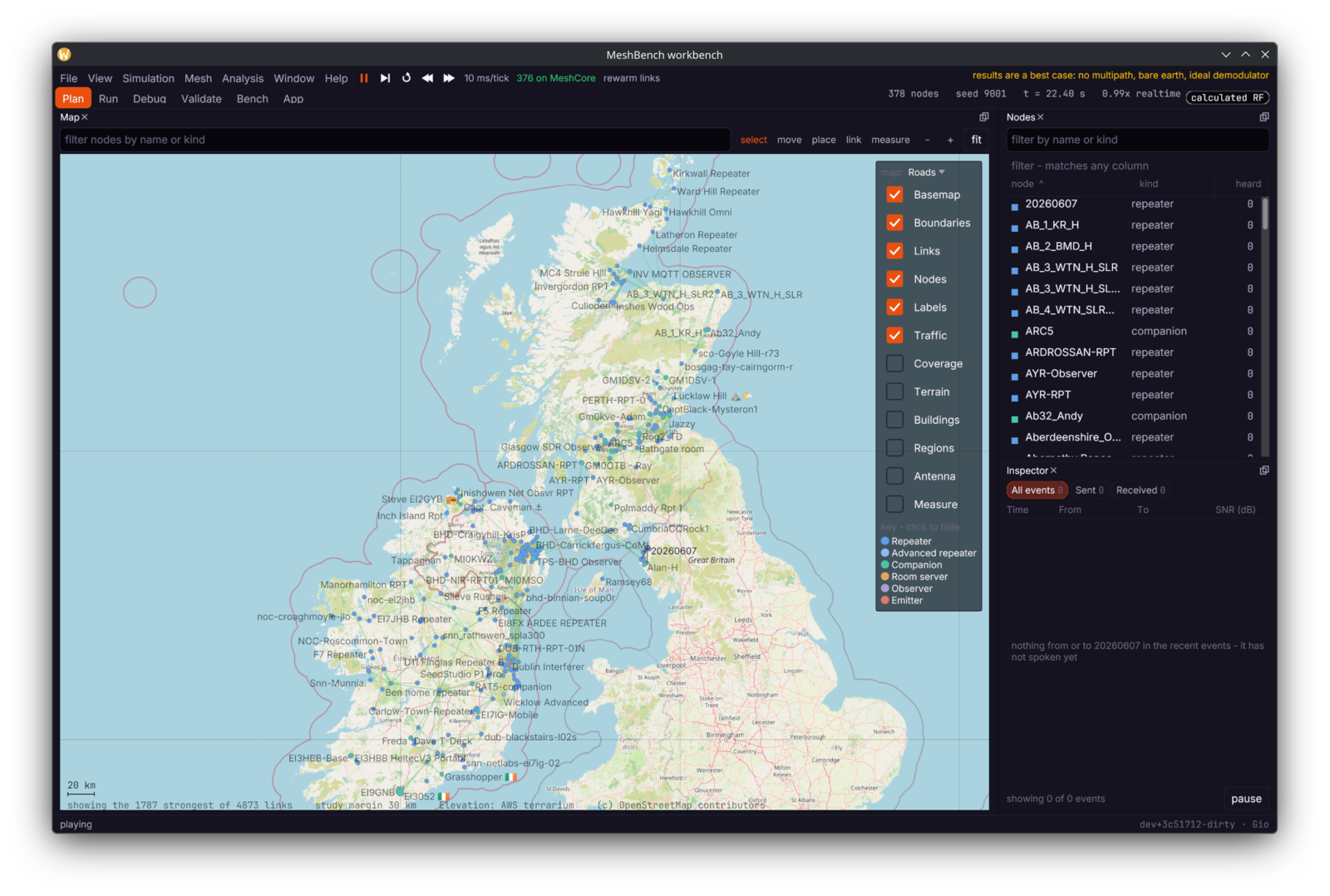
Real networks you can load and run without importing anything, built from live CoreScope with the transport regions the real nodes actually hold. A result on one of these is a result about a real topology rather than about a lattice.
| network | boundary | nodes | repeaters | companions |
|---|---|---|---|---|
fixture-fife | Fife | 58 | 46 | 9 |
fixture-scotland | Scotland | 161 | 142 | 16 |
fixture-scotland-ireland | Scotland, Ireland and Northern Ireland | 378 | 336 | 39 |
Each carries one of every node kind that exists: simple repeater, advanced repeater, companion, room server, SDR observer and emitter. The imported network supplies the repeaters and companions because that is what ScotMesh has; the other four are placed, and they hold the regions their nearest neighbours hold.
Loading one#
- File, then Open a saved network.
- Choose a fixture.
-strictor-permissive; read the next section before choosing. - Simulation, then Start firmware on every node, and wait for the count to reach the node total. At 378 nodes this takes a minute and about 4 GB.
- Press play.
{"id":1,"method":"project.open","params":{"name":"fixture-scotland-ireland-strict"}}
{"id":2,"method":"sim.start"}wb.project.open("fixture-scotland-ireland-strict")
wb.sim.start()
wb.firmware.wait_started(timedelta(minutes=10))if err := wb.Project().Open(ctx, "fixture-scotland-ireland-strict"); err != nil {
log.Fatal(err)
}
if err := wb.Sim().Start(ctx); err != nil {
log.Fatal(err)
}
if err := wb.Firmware().WaitStarted(ctx, 10*time.Minute); err != nil {
log.Fatal(err)
}Strict and permissive, and why it matters#
-strict carries the regions the real nodes hold and nothing else. Use this for "would this work on ScotMesh", because it forwards what ScotMesh forwards and drops what ScotMesh drops.
-permissive additionally types region allowf * into every transmitting node at boot. It was written in the belief that the wildcard is the parent of every region, so a flood would be forwarded whatever its scope.
The two fixtures behave identically. MeshCore matches the wildcard against *unscoped* floods only, and a factory-fresh node's wildcard already allows them. A scoped flood is matched against the node's named regions alone, and the wildcard is not among them. So
region allowf *clears a deny a fresh node never had, and never makes a scoped packet forward. That is why a controlled run flooding a scope only one node holds gave 51 transmissions and 521 receptions strict against 51 and 520 permissive: the same configuration, measured twice. Use strict. The permissive file is kept so a fixture that has typedregion denyf *somewhere can undo it.
What a mesh with no regions applied actually does: it relays every unscoped flood, adverts included, exactly as widely as one with them, and drops every scoped packet without a word. What infer.apply changes is which scoped traffic each node forwards and, through the default scope it sets in the same stroke, whether the mesh's own traffic is scoped at all.
The meshbench test runner prints a PERMISSIVE: line when one is loaded; the workbench does not yet announce it.
The # asymmetry#
A region is spelled two different ways and both are correct:
| where | form | example |
|---|---|---|
| repeater console | bare | region put sco |
| scope on the wire | #-prefixed | #sco |
The key in the packet is sha256("#sco")[:16]. Ask a companion to send with scope sco and it keys its packets sha256("sco"), which matches no repeater in existence: every one of them receives the packet, derives a different key, and declines to forward it. There is no error anywhere. Write the scope with the #.
Running one as a test#
meshbench test -fixture fixtures/fixture-fife-strict.json -junit out.xmlReal firmware on every node, the fixture's assertions checked, JUnit written, and a non-zero exit if anything failed. The assertion shipped with each fixture is deliberately one: "at least ten unique deliveries", which fails the moment a mesh stops relaying.
There is no duty-cycle assertion, on purpose. The runner adverts every node inside the first thirty seconds so a run has traffic quickly, and a busy repeater relaying fifty-six adverts in that window reached 37% duty, far above anything a real network shows where adverts are hours apart. Asserting on that would be asserting on the harness.
Provenance#
Built 12 August 2026 from live CoreScope, 37,870 packets over 168 hours of traffic, regions inferred and applied. Imported nodes are filtered at ±1 km position uncertainty: a node whose position is a guess would answer a reach question with a guess.
There is no sensor kind in the model, so no fixture has one. MeshCore publishes sensor builds and the firmware catalogue parses the role, but the simulator's node kinds are repeaters, companion, room server, observer and emitter. Said here so a reader is not left wondering.