Reading a result
A MeshBench result is a measurement made under stated conditions. This page is what the numbers mean, and how far to trust them.
Every event carries a cause#
The event log records why, not just whether. A reception that failed says what happened: below the demodulator floor, corrupted by overlap, the radio was transmitting, nothing relayed it. The full cause table and the workflow for chasing one packet are in Debugging packet delivery.
Every result carries its provenance#
The RF mode (calculated or waveform), the seed, the realism switches and the fixture's strictness are stamped into every saved run, and the status bar shows them while it plays. Two runs under different provenance are not comparable, and the application will not quietly pretend they are.
The one rule: kinder than the air#
The model has no multipath, no body loss, no oscillator drift, and bare-earth terrain unless buildings are loaded. Nearly every known bias makes simulated links *better* than real ones, and that direction is what makes results usable:
- A link that fails in MeshBench fails in reality. Believe the failure.
- A link that works marginally may not survive the air. Go and measure.
- Absolute numbers are a best case. Delivery counts, margins and coverage edges are upper bounds, not predictions.
Accuracy and limits is the full account, kept current with the code.
Comparisons survive what absolutes do not#
Both arms of a comparison are flattered by the same biases, so the *difference* between two runs is far more trustworthy than either run alone. This is why the serious workflow is an experiment: a control arm, one changed variable, several seeds, and a delta read against the control's own spread.
A single run of a single seed is one draw. Treat a difference found that way as a hypothesis, not a finding.
When to validate against hardware#
- Marginal links that matter. If a plan depends on a link the model gives a few dB of margin, measure it on air before trusting it.
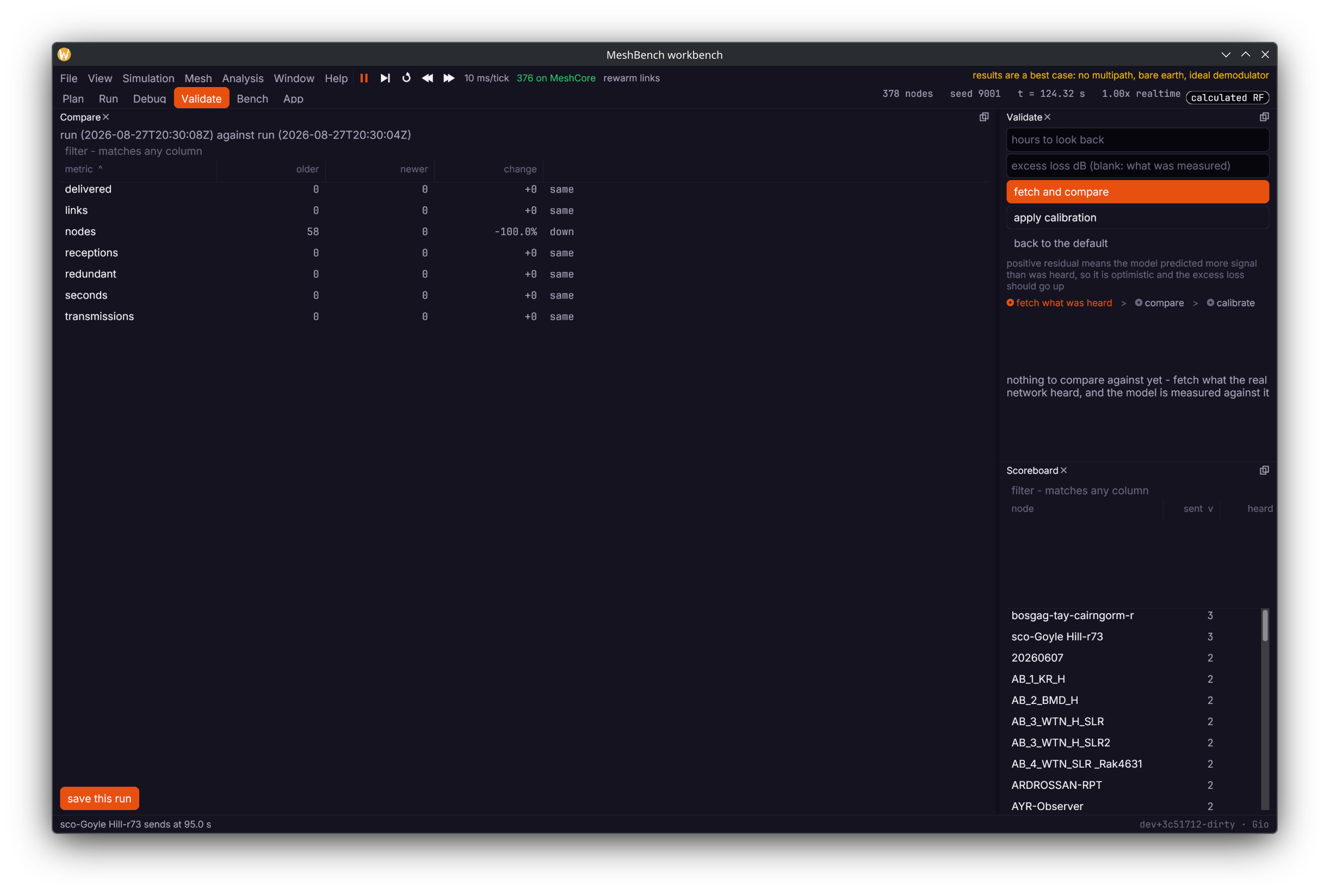
- The model itself. The Validate view: fetch what was heard pulls a real network's receptions, compare sets them against the model's predictions, and apply calibration fits the residual into an excess-loss term. A positive residual means the model predicted more signal than was heard, so the excess loss goes up.
- The physics. The waveform chain is held to real silicon by captured golden vectors: frames from a real SX1262, decoded end to end by MeshBench's receiver.